
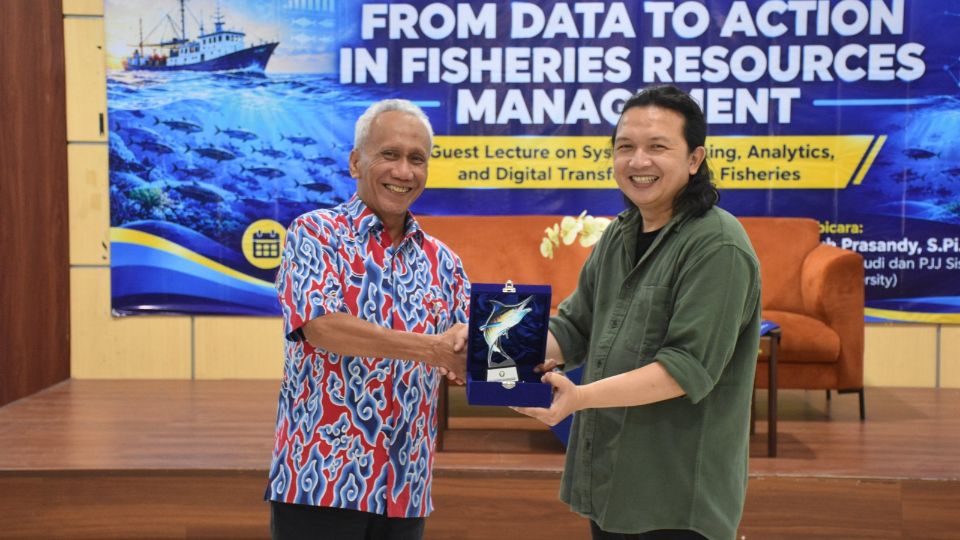
(Semarang, 7 October 2026) – Advances in digital technology have transformed the way various sectors interpret data and make decisions, including the fisheries sector. Data, which was previously viewed largely as a matter of record-keeping and documentation, now plays a far more strategic role: it forms the basis for assessing the state of resources, identifying patterns, formulating policies and determining management actions. It is this spirit that characterised the series of ‘Alumni Mengajar’ events organised by the Bachelor’s Programme in Aquatic Resource Management (MSP), Faculty of Fisheries and Marine Sciences (FPIK), Diponegoro University, on 6–7 October 2026.
The event featured Teguh Prasandy, S.Pi., S.Kom., M.Kom., from the Information Systems Programme and Distance Learning Programme at BINUS University. As a fisheries alumnus specialising in information systems, Teguh offered an interdisciplinary perspective. The challenges of fisheries digitalisation today cannot be adequately addressed merely through an understanding of the ecosystem, but also require the ability to manage and translate data into decisions.

Presentation by Mr Teguh Prasandy, S.Pi., S.Kom., M.Kom.
Closed-door Discussion: Linking Data and Decision-Making
The ‘Alumni Teach’ series began with a discussion on the digitalisation of the fisheries sector on Tuesday, 6 October 2026, in the Common Room of Building D at the Faculty of Fisheries and Marine Sciences, Undip. Organised as a small-group session with a maximum of 25 participants, this forum provided an interactive space to discuss the challenges of digitalising the fisheries sector.
The implementation of digitalisation in the fisheries sector is not merely a matter of switching from manual record-keeping to electronic data. True transformation occurs when technology is able to connect data, people, processes and decision-making needs.
For students of Aquatic Resource Management, various fisheries data—ranging from catch volumes and fishing activities to environmental conditions—are of great value when properly integrated. However, digital transformation requires a comprehensive understanding:
What data is required?
Who generates the data and how is its quality maintained?
How does the data interconnect to inform decision-making?
General Lecture: From Data to Action in Fisheries Resources Management
The discussion on the digitalisation of the fisheries sector continued with a guest lecture on Wednesday, 7 October 2026, at the FPIK Undip Auditorium. The guest lecture was entitled ‘From Data to Action in Fisheries Resources Management: Guest Lecture on Systems Thinking, Analytics, and Digital Transformation in Fisheries’.
The concept of ‘from data to action’ is of paramount importance because the availability of large amounts of data does not automatically lead to better management. Therefore, data must possess quality, context and interconnectivity in order to be relevant for decision-making.

Q&A with Participants at the Public Lecture
Shaping the Future of Multidisciplinary Fisheries Management
This series of activities demonstrates that the management of fisheries resources increasingly requires a multidisciplinary approach. Today’s fisheries students are not only dealing with the sea and ecosystems, but also with databases, dashboards, data analytics and even artificial intelligence (AI).
For the MSP Undergraduate Programme at the Faculty of Fisheries and Marine Sciences, Undip, this event serves as a reminder that the future of fisheries resource management will be determined by the ability to build bridges between science, data, technology and management decisions.

The excitement of the public lecture on the digitalisation of the fisheries sector
